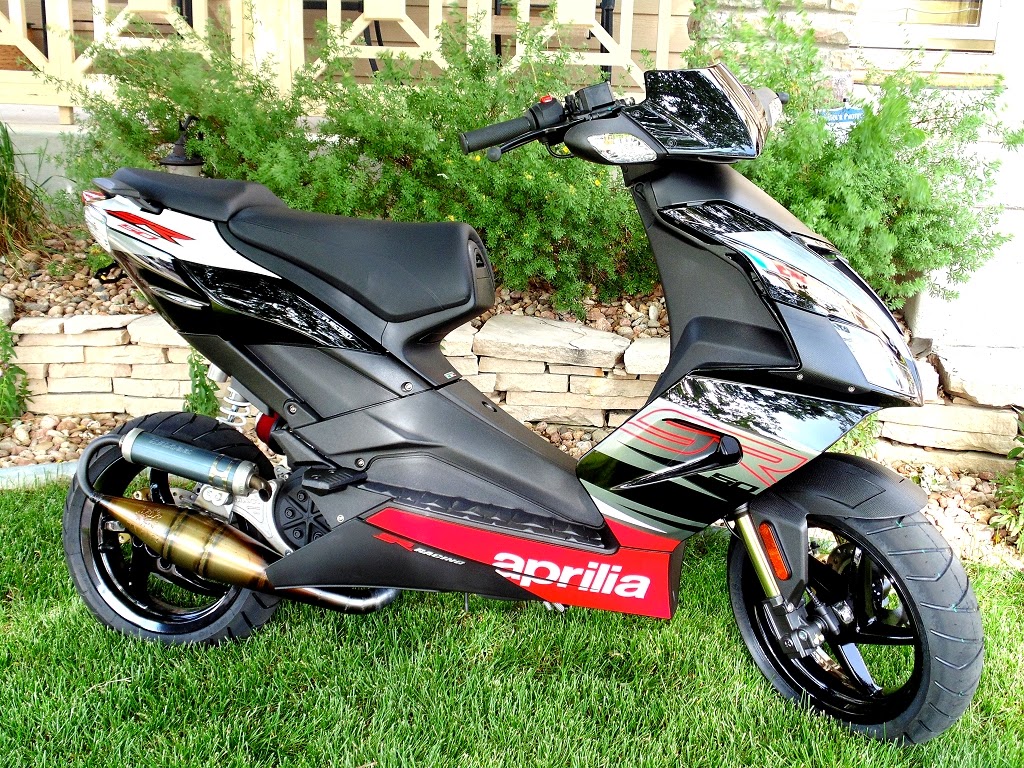
This 86cc SR50 build had only a couple requests... Make it fast and keep it stock looking.
Well, stock looking is where it stops. As soon as you start this SR with the electric start you know it is far from stock. Not only is it screaming fast, nearing 100 mph in my latest setup test ride it has a full functioning starting, charging, lighting and gauge package, just the way it came from the factory.
With your average 70cc to 86cc SR50 mod, they lose a lot of the features that allow it to be on a public road. CDI ignitions are nice but there are few with a lighting coil and even those are barely enough to light a single headlight. The factory transistorized ignition system is a 40,000 volt system with a large charging system. Adding just the Malossi Digitronic forces you to lose nearly every dash feature but the fuel gauge.
Doing some custom wiring and implementing the OEM ECU I bring back all of the original electrical features yet still have a racing advance curve. This SR is definitely one Big Bad Wolf.
Finishing up the one and only Malossi Replica I will be doing. A ton of hours were put into this as well as many one off machined parts. Malossi takes the old carbureted SR50 to build into a race scoot. This was a new DiTech to start with. This is also an 86cc rather than the Malossi 70cc.
Just arrived from Malossi for testing... 70cc Aluminum Piaggio cylinder / Nikasil bore / 2 ring piston / chamfered ports. Suppose to be 9HP out of the box.
Well an 86cc DiTech would be nice but in speaking with Malossi the European sales determine production and they do not have enough European Ditech sales to justify the production. Since Malossi has been in business since 1930, It's safe to say they don't make what won't or cannot sell. We have definitely seen that with The Franco Morini engine. Early fear that the company would fail did come true but not until 4 years of European engine sales and another 3 years worth of leftovers shipped here. A different engine bore, stroke and cylinder bolt pattern doomed it from the beginning. They didn't stop there... The crank and transmission input shaft splines are also unique so we couldn't use Minarelli components.
The Piaggio engine has now been in the SR50 for 10 years but the Ditech sales are still weak in comparison. Personally I just love the sound of a 2 stroke twin or triple. My last 2 stroke big bike was a Kawasaki 750 H2 Mach IV that I purchased from a best friends older brother who was later killed in an auto accident so the family wanted to purchase it back which wasn't an issue. My best friend and I still rode together a lot. Tim rod the 750 Triple and I had purchased a new 1000 Z1R. That 750 (if you could keep the front wheel down) would stay right on my rear wheel for a quarter mile.
With 10 years of Piaggio parts being available including a lot of Ditech parts being removed and thrown away, why not a 140cc Ditech twin. A couple companies, Christofolini being one of them make (on demand) a twin conversion for the carbureted Piaggio case for a staggering $3500.00. I will bet their sales of that conversion could be counted on one hand and anyone with one would surely have it on YouTube which I cannot find even a hand full of owners.
It may not sound like it but a 140cc twin Ditech would actually be quite easy to produce. The most expensive item would be the center case and crankshaft. Neither of which for a 70cc setup would need to be near as robust as what is being made now. It's not hard to join 2 crankshafts together which is what the current providers are doing. A fair amount of time is involved in designing the center case which by design is mostly based on each half of the existing case.
As soon as I have my Piaggio case scans in hand I am going to put a center section together and show it to my local machine shop which has no problem doing one off work. For the crankshaft the best place to have that made would probably be a shop that already does crank repair and balancing. A 140cc twin won't break the bank and current performance variator and clutch components will hold up under normal use. The reason for the case scans are to produce an engine without the integrated transmission so a separate transmission or separate variator system can be used. Of course the integrated case being already available would be the cheapest option.
This Dyno run is a stock (restricted as the Dealer receives it) 2009 SR50 with the Piaggio engine.
It would not rev over 8000 rpm while producing power and would not exceed 45 mph as tested. The speedometer has no influence in the speed restriction as the front tire does not turn on the Dyno.
Here is the single 3.80 hp graph with rpm. Most of the hp is in the upper 7k range. It does run up to 9k but all the power has dropped off.
The gain that can be achieved by loading v. 2.8.0 (Dealer Development Mode) into the DiTech ECU.
Increase in acceleration, Restricted ECU (blue) vs Derestricted ECU (red)
And here's what you get when you remove the variator spacer.... another 7 mph. Difference in HP is probably just difference in conditions.
A comparison of Restricted to ECU derestriction and spacer de-restriction
Rollers changed from stock 5.3gr to 5.1gr LeoVince. Same rollers that ship with the LeoVince ZX-R. No horse power change but a quicker rise in RPM's.
First pipe tested. LeoVince ZX-R.
This pipe in my opinion was as quiet as stock. Produced .84 more horse power, 6 more MPH and 940 more RPM
Tecnigas RSII VS LeoVince ZX-R
The RSII ran very poor from idle to mid throttle and is clearly not a 49cc pipe. Loss of HP, RPM and speed over the ZX-R. A larger reed block and more fuel may help but I will test again at 70cc.... I will bet it does much better.
ZX-R, RSII and Stock together
I put the ZX-R back on and added the HGT adjustable Regulator....
We have felt what it does, now we can see what it does. Very obvious that it smooth's out the power and lets the pipe work much better.
A comparrison of stock, derestricted, ZX-R pipe and HGT Regulator.
What an improvement !
LeoVince ZX-R vs the LeoVince GP... this may make GP owners happy but it does fall off quicker and lost some top end. Although peak HP is just .1HP lower it is .2HP lower in the mid range and .4HP lower on the very top end. You will notice from 35mph to 45mph they are near identical.
I did test the GP with the little baffle out and after 3 runs there was no proof it helps or hurts other then it is louder.
This is the ZX-R with the silencer removed. If the ZX-R produces less HP then the ZX, it's not because of the longer quieter silencer as it may have even lost a little with it removed.
It is definetely ear popping....
This is a set of runs I did to help determining the best roller / scooter speed to start the graphs at. Under 10 mph the transmission shouldn't have much if any transition going on. A standing start is hard to graph consistently but 5 and 10 mph are very repeatable. This will show you the higher you start (above 10mph) the lower your peak HP will be.
This is a graph of the corresponding engine speeds.
This is a back to back run with the derestricted OEM ECU and then with the 70cc Malossi module added. It idles good but the part throttle is terrible. If you were racing in a 49cc class this could be helpful, but then again, the HGT Regulator took us from 5.16HP to 5.58HP with no part throttle issues.
Just as I felt with the butt dyno, the 3 degree advance key added bottom end... not earth shattering but for $8.49 it is the highest HP gain item per dollar. Since 2t's need to retard their timing as rpm's increase, you can see where the HP starts dropping off quicker at the top. On the street you may not hit the point where it starts to drop off.
Here's the LeoVince Shoot-out at 49cc.
All pipes were tested back to back at 60F. A little cooler then most my other tests.
All pipes were tested with supplied 4.8gr rollers from LeoVince
Each pipe was fully warmed up and ran 3 times. The top run was graphed.
The order of the pictures is the order they were tested in.
This is what all 9 runs look like.
Here I have added RPM to the graph. The RPM's are holding just above 8000 as the variator transitions and peak HP is just under 8200.
This is the 70cc kit (no adjustments) compared to the 49cc with the ZX-R pipe and tuned. The transmission was all over the place, up and down.
This is where we have come from stock 3.80 HP 49cc to 70cc. This is after adjusting out the clutch and rollers..... much smoother. The engine will pull 6.50's consistently and has pulled a 6.62 with the ZX pipe but the ZX-R is holding a higher HP throughout the run where the ZX is peaking and falling off faster.
Quite a change from the show room floor Horse Power.
Here's the 4 pipe shoot-out at 70cc between the LeoVince ZX, ZX-R, GP and Tecnigas RSII. When I saw the numbers from the GP I about fell over, then after plotting with the rest of the pipes I could see it fell off fast. The RPM's were also much higher so I am wondering what it will do if I fatten up the rollers and hold the RPM's lower for it.
Here's the difference in case matching and porting the Morini with a Malossi BBK vs bolt on. 1 HP increase and .63 foot pounds of torque. The fall off occurs more at higher rpm's. Top speed and 0-60 significantly different.
I wasn't expecting this when I was asked for a short write up of what I thought of my new SD12 DynoJet Dyno. To get The High Gain TuningLogo plugged as 1 of the US"Top Race Teams and Tuning Shops"when there are Thousands of DynoJet Dyno's sold here shows the commitment and dedication we have made to be the best at what we do.
To even be on the same page with Vance & Hines is an honor. I can see why I was featured on the catalogs SD12 page being the first Scooter Tuning shop or any shop for that matter to purchase the SD12 but that was even over the top.
High-Gain Tuning ("HGT") located in Parker Colorado develops, manufactures and markets products deemed instrumental in unleashing the hidden power of the Ditech based scooter engines while still maintaining unsurpassed fuel economy and low emissions.
On any 2T engine that is tuned for higher performance the power band will be raised into a tighter (peak) RPM area mostly due to the addition of an expansion chamber style performance pipe and the cylinders port timings. The DiTech isn't much different but the RPM isn't raised as high as a non-direct injected engine because the stock port timings and even the 70cc kit port timings are pretty tame. The DiTech was intended to be an ultra clean fuel efficient two stroke and the stock bower band is very broad but the restricted power outputis only 3.8HP, 4.4HP derestricted.
Most performance parts available for the Piaggio based SR50 DiTech are carryovers from the carbureted days of the Piaggio and were never intended for the DiTech. There's nothing wrong with that as long as you don't use information gathered from a non-DiTech Piaggio setup to tune your DiTech.
To get the best performance from a constant velocity transmission (CVT) based two stroke scooter such as the SR50 DiTech, the optimum RPM band must be maintained throughout the entire transition of the variator as seen in this video.
To govern that RPM from start to finish with as little RPM variation as possible a combination of variator roller weight, clutch spring tension and contrast spring tension must be chosen. Each of these serve a separate purpose but 2 of them, roller weight and contrast spring tension must have a balance.
Clutch spring tension
The clutch spring tension will determine when (what RPM) the clutch shoes start to come in contact with the clutch bell, until then the engine will spin up freely and with little effort. Where the lower power band begins (RPM) is where the shoes should start to engage the clutch bell. From idle to that RPM you want the engine to rev effortlessly so by the time you start to move the engine is already at an RPM where it begins making it's best power.
In the Dyno graph below comparing a 70cc DiTechengine to a 86cc Race engine the blue and red circles show where the lower power band begins. The blue and red ovals show where the power band peaks. Despite your riding preference, you should not let your clutch engage below the circled rpm or you will experience poor take offs and possibly never get the engine into its peak power band.
With the power band known you can better choose where you want the clutch to engage. The two extremes would be comfortable street use on one end and drag racing on the other.
A comfortable street use engagement would be at the bottom of the power band. That will allow the engine to make good power and have a smooth take off but you will feel and hear it get stronger as the rpm's get higher toward the peak. An example of that on the DiTech engine would be where the circle begins or slightly after (6500 rpm) but not before.
A drag racing setup should engage just below the peak rpm so most of the power is already made but not so high that the clutch slips. It's all or nothing when drag racing so a good engagement rpm on the race engine graph would be 10,5000.
Roller Weights
As the engine rotates, the roller weights create the centrifugal force necessary to push the front variator pulley halves together.In their relaxed position (idle) they allow the pulley halves to relax and let the drive belt fall to its lowest range position needed for starting out.
The faster the engine rotates, the more force that will be created to push the pulley halves together and the drive belt higher up the pulley to its highest range needed for cruising.
Contrast Spring
At the rear of the transmission is the fixed pulley half, movable pulley half, contrast spring and clutch. The job of the contrast spring is to push the movable pulley half together so that the drive belt is forced to its highest position of the fixed pulley, this puts the transmission in its lowest range. Since the drive belt doesn’t stretch, that pulls the belt down into the lowest part of the variator.
If the rollers weights are responsible for pushing the drive belt one way and the contrast spring tension is responsible for pushing it the other, a balance in pressure must be maintained so the pulley halves not only transition easily and at the correct time but that the drive belt stays tight. This balance is pretty good when the scooter is stock but few of us tend to keep it that way.
Keeping it balanced
An imbalance starts as soon changes are made to the two stroke engine to make it more powerful. Since this is a CVT scooter and we cannot choose its RPM shift points manually so that it stays in the power band, we have to adjust the transmission to do it for us and do it properly.
Something as simple as changing the pipe isn't so simple on a CVT 2 stroke scooter. For an expansion chamber pipe to perform at its peak, it has to operate within a specific pulse frequency and temperature. If the temperature needs to be at a specific temperature, the manufacturer will instruct you where that should be and ways to help get it there.
For the pipes available to us the design is so that we can usually leave our engines running at their factory desired temp. This doesn't mean that part number XYZ performance pipe is going to operate the same on every engine at every location. For any performance pipe that we can add it has been tested to perform best at its fully warmed up temperature. If your going to putt around the neighborhood and never get your exhaust blistering hot, do not add a performance pipe then complain about your performance or lack of.
Some pipe manufacturers like LeoVince will include components such as stiffer clutch springs and lighter rollers to help re-balance the transmission so the owner has a better experience. Others just hope you know what the hell your doing, or don't really care.
Are you grasping this?
Now if you have been paying attention, you know why they included stiffer clutch springs and lighter roller weights. Your new pipe has a power band that is higher than your stock pipe but also starts at a higher rpm. Therefore the stiffer clutch springs will hold off the clutch engagement until the rpm's have reached the point where the pipe is making good power and won't get bogged down before it gets a chance to work.
The lighter rollers are necessary to keep the centrifugal force (balance) the same at your new (higher) operating rpm. If you fail to install the lighter rollers the force the heavier rollers create at the higher rpm will start to compress the contrast spring too quickly causing your transmission to up-shift prematurely.



.jpg)


